

Usability testing focuses on the quality of user interaction with software products. A usable product reduces learning curves, improves work efficiency, minimizes operational errors, and enhances user satisfaction and product retention.
Through user research and usability assessment methods, we thoroughly evaluate interface design, interaction flows, and information architecture.
Assessment Methods
Usability testing combines qualitative analysis and quantitative evaluation to measure user experience from multiple angles.
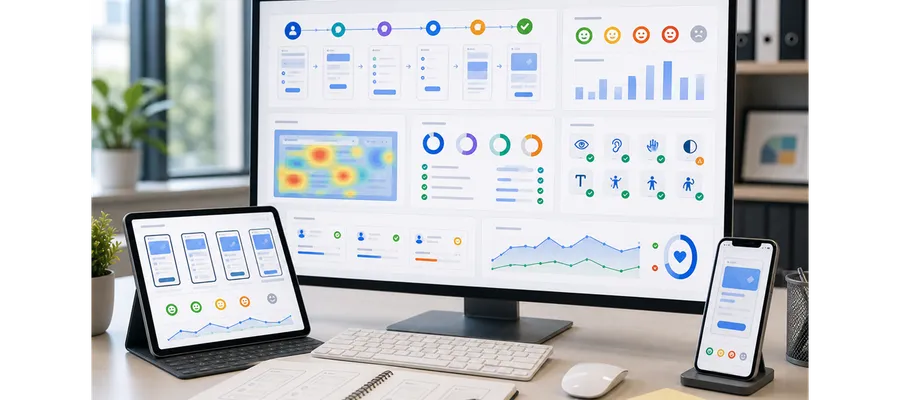
We engage real users in testing to collect objective feedback and behavioral data.
Testing Basis and Evaluation Dimensions
In accordance with GB/T 25000.51-2016, Systems and Software Engineering — Systems and Software Quality Requirements and Evaluation (SQuaRE) — Part 51: Requirements for Quality of Ready-to-Use Software Products (RUSP) and Instructions for Testing, software product usability can primarily be evaluated in the following areas:
- Appropriateness Recognisability
- Learnability
- Operability
- User Error Protection
- User Interface Aesthetics
- Accessibility
Experience Optimization
Based on usability testing findings, we propose specific interface and interaction improvements.
Interface Evaluation
Comprehensive assessment of layout, navigation, information presentation, and interaction feedback.
Make your product not only powerful but also simple and enjoyable to use.